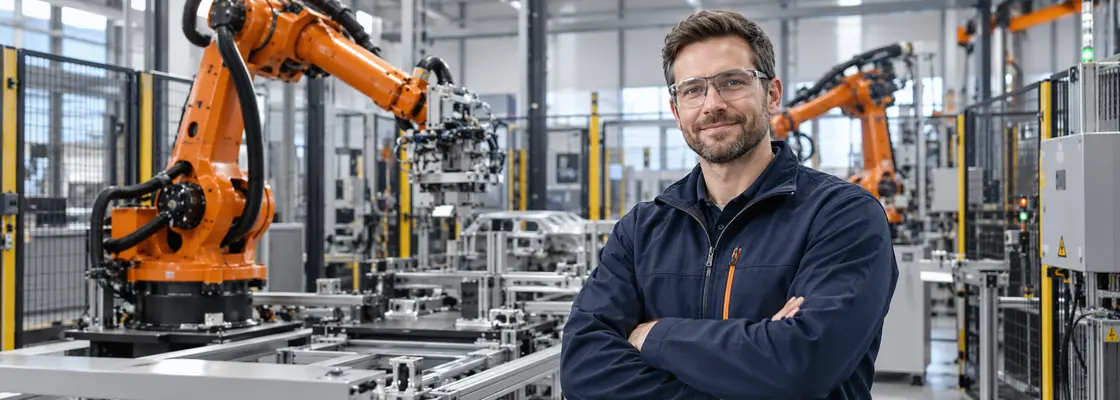


Production & Manufacturing
AROBIS makes manufacturing processes more efficient, more stable, and flexibly scalable.
[ Production & Manufacturing ]
End-to-end processes instead of isolated automation islands
AROBIS automates repetitive production steps, connects workstations, and creates flexible processes for manufacturing companies facing growing demands.
In production, bottlenecks often occur at handovers, buffer locations, or manual intermediate steps. AROBIS looks beyond the individual robot’s material flow and develops solutions that meaningfully connect machines, inspections, and assembly. The goal is stable cycle times and a transparent production flow.
Typical applications
End-to-end automation for material flow, machining, assembly, inspection, and controlled handovers.
- Machine loading, assembly, and component handling
- Buffers, conveyor technology, and controlled transfers
- Integrated inspection and unambiguous error rejection
- Flexible cells for series, variants, and changeovers
- Traceable rejection of faulty components
Let's discuss a project for this industry
Tell us about the component, process, cycle time and boundary conditions. We assess the task from a technical perspective and clarify the next sensible steps.
[ Production & Manufacturing ]
Production & Manufacturing: requirements and solutions
In production, bottlenecks often occur at handovers, buffer locations, or manual intermediate steps. AROBIS looks beyond the individual robot’s material flow and develops solutions that meaningfully connect machines, inspections, and assembly. The goal is stable cycle times and a transparent production flow.
Identify bottlenecks and automation potential
- Analysis of material flow, cycle time, and manual handovers
- Prioritization based on value, risk, and feasibility
- An automation concept that fits growth and variants
- Camera and measurement systems for direct quality release
- Production system integration and transparent plant status
Flexible linking of machining, assembly, and inspection
- Machine loading, assembly, and component handling
- Buffers, conveyor technology, and controlled transfers
- Integrated inspection and unambiguous error rejection
- Flexible cells for series, variants, and changeovers
- Traceable rejection of faulty components
Your benefits
- Fewer bottlenecks at manual handover points
- More stable cycle times across multiple stations
- Reproducible quality directly in the process
- Step-by-step expandable automation
- Better transparency during downtime and restart
More predictable planning for day-to-day production operations
AROBIS develops automation along the actual production goals. More stable processes, reproducible quality, and less physically demanding work create measurable benefits in everyday use.
[ FAQ ]
Frequently asked questions about automation in production and manufacturing
Answers to typical requirements and automation options in the Production & Manufacturing industry.
Typical applications include machine loading, handling, assembly, inspection, sorting, labeling, packaging, and palletizing.
No. Incremental expansion is possible, provided that interfaces and later extensions are considered from the start.
Recipe management, flexible grippers, interchangeable fixtures, and camera systems can cover different variants.
Order, recipe, or quality data can be exchanged via defined interfaces, as long as the involved systems support this.
Buffers, fill-level monitoring, unambiguous releases, and controlled error rejection prevent a single error from blocking the entire line uncontrollably.
Staffing requirements, cycle time, quality, scrap, ergonomics, availability, and future capacity are considered together.
[ AROBIS industry expertise ]
Why AROBIS for production and manufacturing?
AROBIS doesn’t just look at the individual robot, but at the process between material supply, machine, inspection, and handover.
From analysis to stable operation
Automation potential is prioritized based on value and feasibility. This allows production to grow in a controlled manner without having to rebuild everything at once.