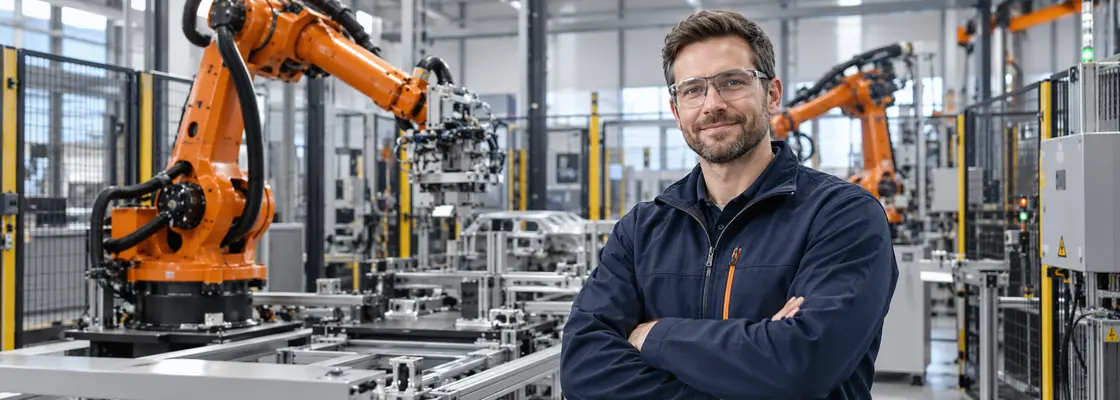


Robotics systems
AROBIS connects robotics, peripherals and control into a reliable complete system.
[ Robotics systems ]
Robotics as a coordinated end-to-end system
A single industrial robot does not yet solve a production task. Only when it works together with parts feeding, gripping technology, positioning, process peripherals, sensing and control does a stable workflow result. That’s why AROBIS designs robotics systems based on the specific task and aligns reach, payload, speed, accuracy and accessibility with each other.
System design based on the task and workpiece
Robot, gripper, fixture, sensing and control are designed as a complete system.
- Sizing of reach, payload and axis motion
- Coordination of the gripper, fixture and peripherals
- Simulation of accessibility and collision zones
- Safe cell and access concepts
- Connecting robots, PLCs, sensing and process data
Discuss the robotics task
We consider the workpiece, motion, payload, reach and peripherals as a complete robotics system.
Robotics systems at a glance
[ Robotics systems ]
AROBIS develops complete robotics systems in which robots, grippers, fixtures, sensors, control and safety work together to deliver a robust industrial solution.
AROBIS combines robot technology with knowledge of real production processes. The result: systems that handle workpieces safely, can be operated in a comprehensible way, and execute the required process with consistent, stable quality.
What we implement
- Sizing of reach, payload and axis motion
- Coordination of the gripper, fixture and peripherals
- Simulation of accessibility and collision zones
- Safe cell and access concepts
- Connecting robots, PLCs, sensing and process data
Your benefits
- Coordinated interaction of all system components
- Safe and traceable robot processes
- The right reach, payload and dynamics
- Practical operation and troubleshooting
- Prepared scalability for new tasks
Our approach
AROBIS combines robot technology with knowledge of real production processes. The result: systems that handle workpieces safely, can be operated in a comprehensible way, and execute the required process with consistent, stable quality.
[ FAQ ]
Frequently asked questions about robotics systems
Key information on selection, manufacturers, variants, safety, programming and expansion.
Depending on the task, classic six-axis industrial robots, SCARA systems, delta robots, gantry axes or collaborative robots may be suitable. The choice depends on the load, reach, dynamics, accuracy, operating conditions and the required safety concept.
The solution is planned based on the application. Manufacturers and components are selected to match the task, technical availability, existing standards and service requirements. Existing customer specifications can also be taken into account.
In multi-robot systems, workspaces, cycle sequence, transfer points and collision avoidance are planned together. Control and programs must use unambiguous permissions and states so that the process remains controlled even in the event of interruptions.
Yes, as long as variants and a setup strategy are defined early. Tool changers, multifunction grippers, adjustable fixtures, camera systems and recipe data can make a robotics system usable for multiple products.
This includes mechanical setup, electrical testing, setting up robot paths, coordinating the peripherals, safety tests, process optimization, acceptance and training. The real application is ramped up step by step until stable automatic operation is reached.
Expansion is much easier if reserves are planned for the controller, installation space, interfaces and the safety concept. AROBIS considers sensible expansion options already during the planning stage.