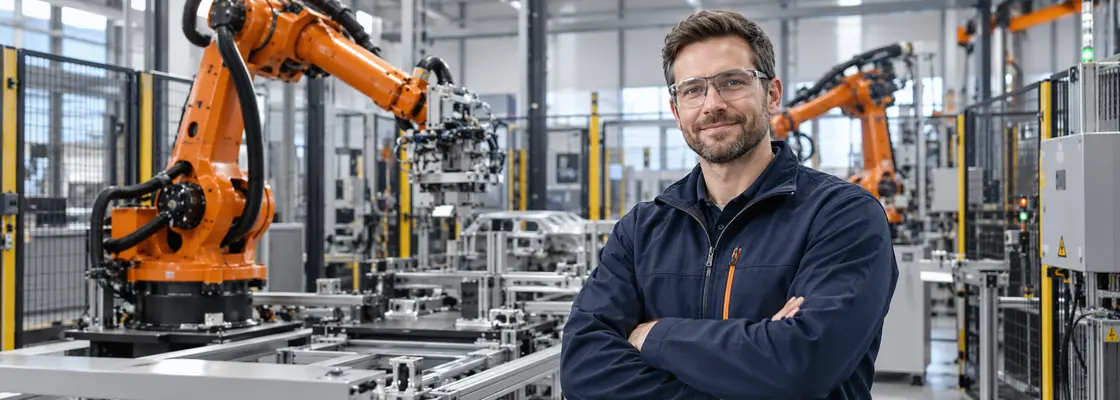


Planning & Engineering
AROBIS turns requirements into well-thought-out, implementable plant concepts.
[ Planning & Engineering ]
Technical planning with an eye on implementation and operation
A system doesn’t just have to work on the screen. It must be built, set up, operated, maintained, and later adapted. That’s why AROBIS combines concept work and design with practical production experience. Requirements, interfaces, and acceptance criteria are structured before the details are defined.
Requirements, feasibility, and simulation
Feasibility, simulation, and design create a reliable basis for costs, schedules, and implementation.
- Requirements and interface clarification close to the specification document (LoE)
- Feasibility studies, layout, and robot simulation
- Cycle-time and variant evaluation before detailed design
- 3D design of plants, grippers, and fixtures
- Consideration of assembly, maintenance, and safety
Request planning support
We translate process data, components, and performance targets into a robust concept with clear interfaces.
Planning & Engineering at a glance
[ Planning & Engineering ]
AROBIS translates industrial requirements into robust automation concepts—starting with process capture and feasibility, through simulation and design, up to the approved implementation.
AROBIS creates a traceable technical foundation for investment and implementation. The clearer the process, interfaces, and performance targets are described, the more reliably costs, schedules, and plant performance can be managed.
What we implement
- Requirements and interface clarification close to the specification document (LoE)
- Feasibility studies, layout, and robot simulation
- Cycle-time and variant evaluation before detailed design
- 3D design of plants, grippers, and fixtures
- Consideration of assembly, maintenance, and safety
Your benefits
- Early transparency on feasibility and risks
- Reliable layout, reach, and cycle-time evaluation
- Fewer changes during build and commissioning
- Design that supports production, assembly, and maintenance
- A shared technical baseline for all project stakeholders
Our approach
AROBIS creates a traceable technical foundation for investment and implementation. The clearer the process, interfaces, and performance targets are described, the more reliably costs, schedules, and plant performance can be managed.
[ FAQ ]
Frequently asked questions about planning and engineering
Answers about project start, data basis, simulation, design, external components, and changes.
Helpful are component drawings or samples, a process description, the desired cycle time, quality characteristics, layout information, and details about existing machinery. Missing data can be captured and structured together.
A simulation checks reach, axis positions, collision areas, and rough cycle sequences before hardware is procured. It does not replace real commissioning, but it reduces avoidable layout and sizing errors.
Depending on the project, AROBIS can take on individual planning or design services, or support engineering through to integration. Interfaces and areas of responsibility are clearly defined for this purpose.
Yes. Requirements for components, documentation, safety, software structure, or spare parts are incorporated into the planning, as long as they are provided for the project.
Changes are assessed in terms of function, cost, schedule, and interfaces. A traceable approval process prevents different planning versions from being used in parallel.
Safety functions and a protection concept must be considered early in the layout and process flow. Depending on the scope of supply, risk assessment, safety functions, and required inspections are integrated into the planning.