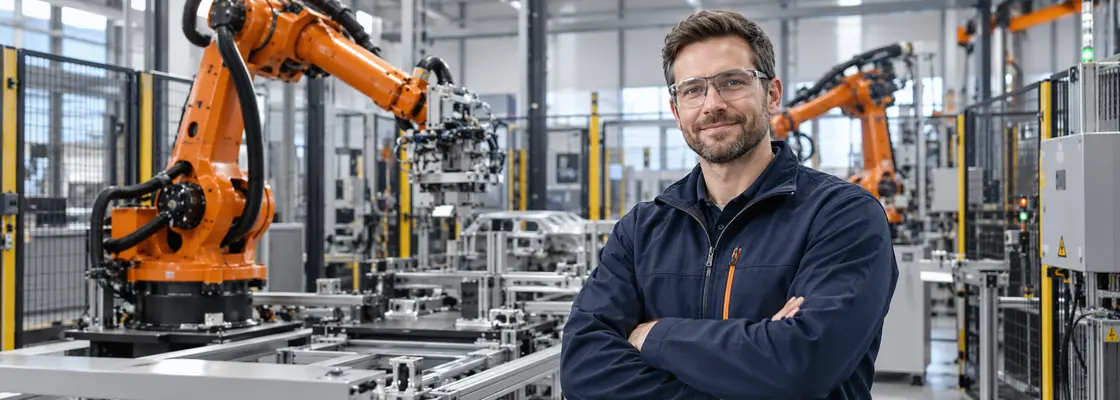


Automation technology
AROBIS brings together process knowledge, engineering, and automation that has been proven in practice.
[ Automation Technology ]
Automation technology that starts from your real process
A cost-effective automation solution doesn’t come from a standard package. What matters are process sequence, variants, component feeding, quality requirements, workplace safety, and the interfaces to existing machines. AROBIS looks at these factors together and develops a robust plant concept that works in day-to-day production.
Process analysis and a robust plant concept
Process documentation, plant concept, and safe integration form the basis for an economical implementation.
- Process documentation directly at the application
- Assessment of cycle time, variants, and component flow
- Concept for robotics, peripherals, and safety
- Mechanical and control-system integration
- Testing, acceptance, and optimization under real-world operating conditions
Discuss an automation project
We review your process, cycle time, components, and interfaces and clarify with you the technically sensible next steps.
Automation technology at a glance
[ Automation Technology ]
AROBIS plans and implements automation technology for industrial workflows that should become safer, more efficient, and more reproducible—tailored to the component, cycle time, available space, and the existing production setup.
AROBIS connects process expertise, engineering, robotics, and industrial implementation. The goal isn’t simply the biggest possible system, but a technically suitable solution that relieves employees, stabilizes quality, and fits economically into operations.
What we implement
- Process documentation directly at the application
- Assessment of cycle time, variants, and component flow
- Concept for robotics, peripherals, and safety
- Mechanical and control-system integration
- Testing, acceptance, and optimization under real-world operating conditions
Your benefits
- More stable and repeatable process steps
- Less manual strain and fewer sources of errors
- Predictable cycle times and transparent interfaces
- Safe integration into existing production areas
- Scalable technology instead of isolated one-off solutions
Our approach
AROBIS connects process expertise, engineering, robotics, and industrial implementation. The goal isn’t simply the biggest possible system, but a technically suitable solution that relieves employees, stabilizes quality, and fits economically into operations.
[ FAQ ]
Frequently asked questions about automation technology
Answers on suitability, project start, cycle time, existing plants, safety, and cost-effectiveness.
Recurring processes that are ergonomically demanding, time-critical, or relevant to quality are especially suitable. Examples include machine loading, handling, assembly, welding, inspection, sorting, palletizing, and linking multiple process steps. The key is always the specific technical and economic assessment.
Yes. Existing machines and production areas can often be enhanced with robotics, feeding systems, sensor technology, or new control functions. First, the current condition, interfaces, safety concept, and available installation space are assessed so that the retrofit can be planned reliably.
Cycle time is built up from all relevant sub-movements and process times. This includes gripping, positioning, processing, inspection, tool changes, and possible waiting times. Simulation and hands-on tests help validate assumptions and identify bottlenecks early.
Yes. Safety devices, access points, safe operating modes, operator workflows, and restart after faults are part of the plant concept. A solution doesn’t just have to be productive—it also needs to be understandable, accessible, and safe in everyday use.
That’s possible if variants, setup processes, and batch sizes are considered from the start. Flexible grippers, interchangeable fixtures, recipe management, and suitable sensing can prepare a system for different components.
Helpful inputs include a brief process description, photos or drawings, component data, desired throughput, and information about the existing environment. After that, we clarify which solution is technically sensible and which next planning steps are required.