

Why AROBIS?
We start with the real process—and develop the technically suitable, safe, and manageable automation from it.
[ Why AROBIS ]
Automation is decided by the process, not by a robot catalog
A good system is not created by installing as much technology as possible. What matters is whether the components, sequence, cycle time, quality, material flow, operation, and space conditions are understood as a coherent system.
That’s why AROBIS first analyzes the real task. Only afterward are robotics, grippers, fixtures, sensors, controls, and safety combined into a robust concept.
[ Process understanding ]
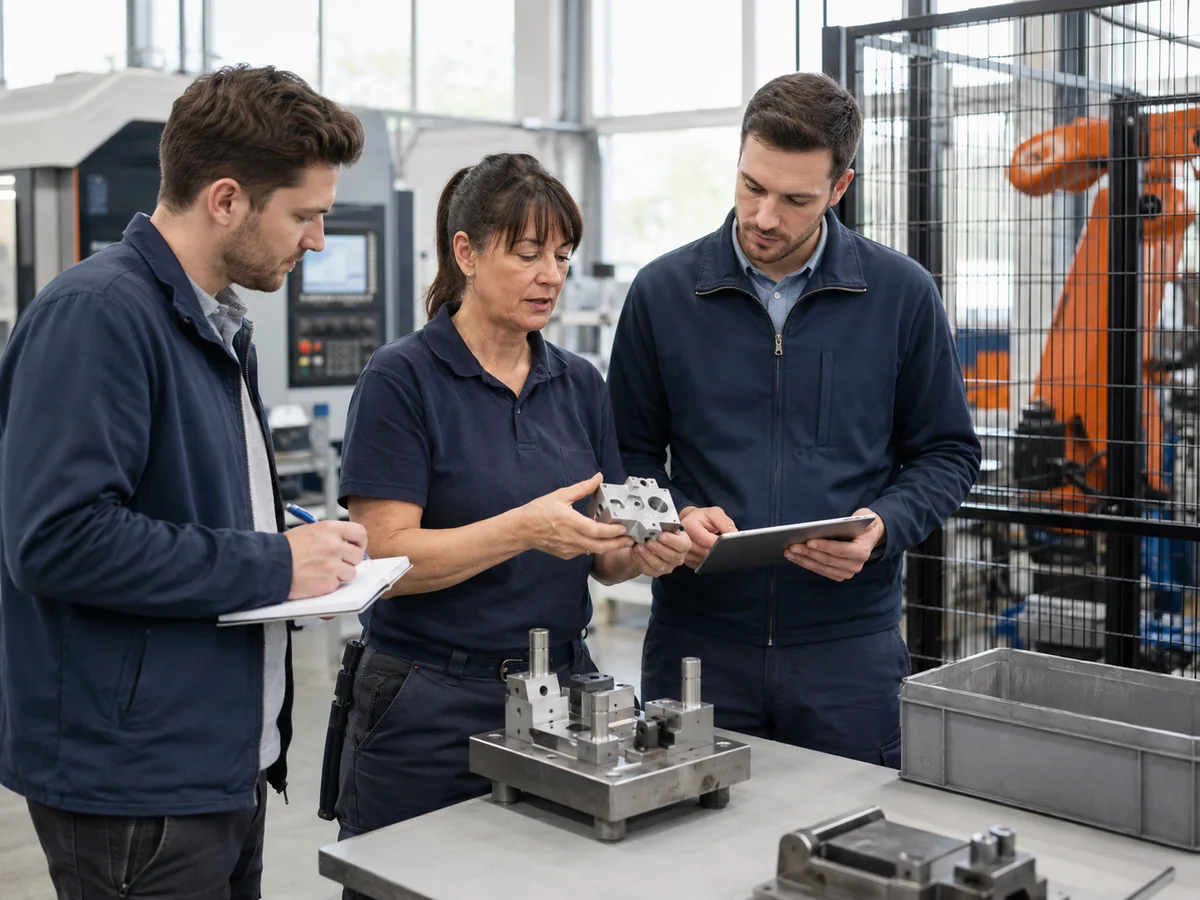
Operator expertise, components, and process steps belong at the same table
Anyone who works with the process every day knows variants, disruptions, and manual actions that are often missing from drawings. This expertise is brought in early.
This is how we avoid a purely theoretical concept and create a solution that realistically accounts for material provisioning, setup, operation, and maintenance.
- Capture the current process and the variants
- Check components and tolerances
- Understand disruptions and manual interventions
- Plan operation and maintenance
[ What makes the difference ]
Technical decisions must remain traceable
AROBIS combines planning depth with clear, easy-to-understand project communication.
01
The right fit instead of maximum
The level of technology and automation is determined by the task and the business goal.
02
Clarify interfaces early
Mechanical engineering, controls, safety, and material flow are not postponed until the build phase.
03
Make risks visible
Assumptions, variants, and technical limitations are explicitly named and assessed.
[ Engineering & Simulation ]
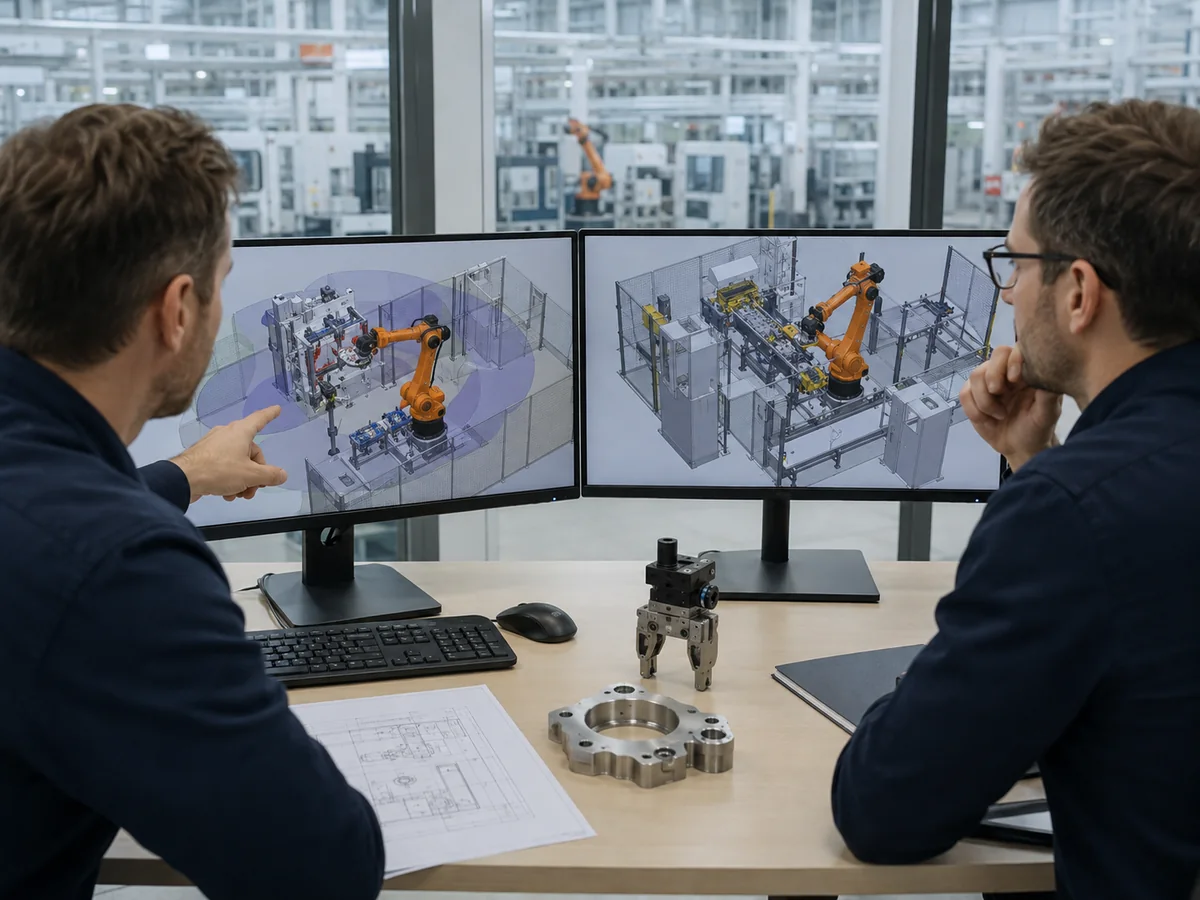
Range, cycle time, and material flow can be checked early
Simulation and engineering verification help identify critical points before production: collisions, unfavorable robot positions, insufficient accessibility, or cycle-time reserves that are planned too tightly.
This does not replace testing on the real component—but it improves the basis for decisions and reduces unnecessary iterations.
- Reach and collision checks
- End-effector and fixturing concept
- Cycle-time considerations and process variants
- Accessibility for operation and service
[ Structured approach ]
From the current process to a stable production ramp-up
Project phases are tailored to scope and current site conditions.
01
Assess
Understand process, component, cycle time, quality, and the operating conditions.
02
Conceptualize
Evaluate variants and develop a technically robust concept.
03
Validate
Check interfaces, simulation, safety, and risks.
04
Integrate
Build components, program them, and test together.
05
Optimize
Refine on the real process and support the ramp-up.
[ Communication ]
Explaining technology in an understandable way
Decisions aren’t hidden behind technical jargon. AROBIS explains variants, dependencies, and consequences so that project stakeholders can evaluate them.
[ Implementation ]
A single point of contact across the phases
Insights from analysis and engineering are not lost once the build begins. The technical line remains traceable through integration and commissioning.
- Open points are documented
- Changes are justified
- Production feedback is incorporated
[ Initial assessment ]
Can your task be sensibly automated?
In an initial technical consultation, we clarify the goal, process, and boundary conditions—without promising a ready-made system too early.
[ FAQ ]
Frequently asked questions about working together with AROBIS
What companies want to know before starting a project regarding approach, scope, and technology.
No. A reliable description of the task, components, objectives, and boundary conditions is enough to get started. Open points are clarified in a structured way.
The selection of robots, control systems, and components depends on the application, technical requirements, availability, and the customer’s standard. Existing plant standards are taken into account.
Yes, provided that condition, control system, safety concept, and mechanical interfaces allow a meaningful extension. To do this, the existing system is first technically assessed.
Among other factors, we consider cycle time, utilization, labor attachment, quality, scrap, susceptibility to faults, and the expected technical effort.
Yes. Accessibility, changeover processes, troubleshooting, spare parts, and understandable operating procedures are part of an everyday-suitable solution.
Depending on the project scope, AROBIS accompanies system build, integration, testing, optimization, acceptance, and ramp-up to production.