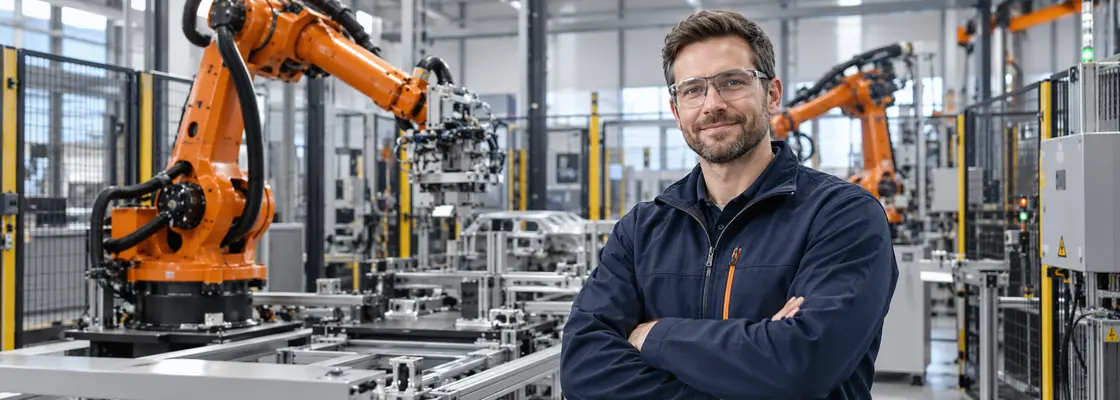


Welding automation
AROBIS combines reproducible welding quality with safe, efficient robotics.
[ welding automation ]
Design welding processes to be reproducible and ergonomic
Automated welding can stabilize quality, relieve skilled workers, and make cycle times more predictable. The prerequisite is repeat-accurate components, suitable fixtures, and good accessibility of the weld seams. That is why AROBIS evaluates the entire process—from loading, clamping and positioning through the welding sequence, extraction, and unloading.
Component, seam, and fixture analysis
Weld seam access, fixture, welding technology, positioning, and extraction jointly determine process stability.
- Assessment of seam position and torch accessibility
- Fixture and positioning concept for repeat accuracy
- Consideration of tolerances, distortion, and heat input
- Integration of robot, welding power source, and positioner
- Optimized welding sequences and repeatable parameters
Discuss the welding process
We evaluate components, seams, fixture, welding sequence, positioning, and safety as a complete process.
Welding automation at a glance
[ welding automation ]
AROBIS develops robot-assisted welding solutions in which the component, fixture, welding process, positioning, and safety are planned as a complete cell.
AROBIS brings robotics, fixture engineering, and the welding process together into a solution that works in practice. What matters are stable starting conditions, understandable operation, and a cell that remains manageable even for variants and maintenance.
What we implement
- Assessment of seam position and torch accessibility
- Fixture and positioning concept for repeat accuracy
- Consideration of tolerances, distortion, and heat input
- Integration of robot, welding power source, and positioner
- Optimized welding sequences and repeatable parameters
Your benefits
- Reproducible welding parameters and seam quality
- Plannable workflows and more stable cycle times
- Relief for manual welding workstations
- Safe cells with practice-oriented loading
- Manageable variant and setup concepts
Our approach
AROBIS brings robotics, fixture engineering, and the welding process together into a solution that works in practice. What matters are stable starting conditions, understandable operation, and a cell that remains manageable even for variants and maintenance.
[ FAQ ]
Frequently asked questions about welding automation
Answers about components, batch sizes, fixtures, processes, quality, and retrofitting.
Well-suited are recurring components with sufficiently stable geometry and accessible weld seams. Even smaller series can be interesting when the setup concept and program changeover are implemented efficiently.
MIG/MAG and TIG processes are often implemented with robot support. Which process is suitable depends on the material, component thickness, seam requirements, and desired performance.
The robot drives programmed paths very precisely, but it cannot compensate for strongly fluctuating component orientations without additional measures. A good fixture creates defined reference points, accommodates tolerances, and ensures weld seam accessibility.
Yes. Changeable fixtures, recipe management, modular locating systems, and suitable programs enable variants. In advance, it is assessed how often changes are made and what setup time is economically feasible.
Stable component preparation, defined parameters, controlled wire feeding, and appropriate welding sequences form the basis. Depending on the requirement, seam searching, process monitoring, or downstream inspections can be added.
That is often possible. For this, space, extraction, welding equipment, power supply, component supply, and safety requirements are assessed. Afterward, it can be determined which components can be reused.